
Reviewed · WALKING TOURS
1.5-Hour Small-Group Nightwatchman Walk in Medieval Lucerne
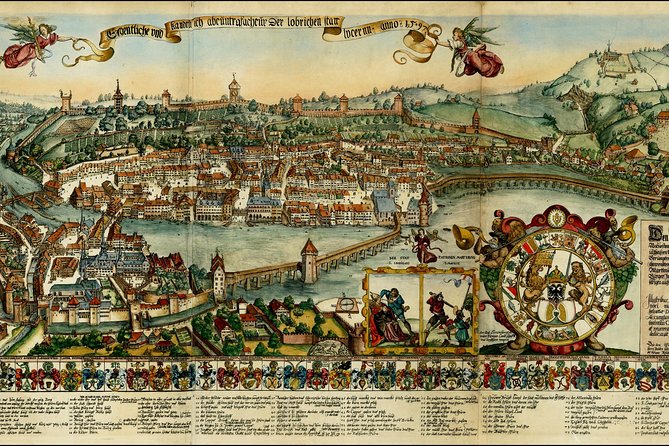
Lucerne’s old town takes on a different character after dark, when the streets quiet down and a costumed Nightwatchman leads you through stories of fire, crime, faith, punishment, and daily life. This is not just a stroll past pretty facades. You’ll use the 1597 Martini plan to follow medieval Lucerne, then see how much of that old street pattern survives.
I like the visual aids, especially the projected paintings and maps that turn a stone wall or bridge into a history lesson. I also like the compact group size, capped at 15, and the small details: a taste of fountain water, old measuring tools, ghost stories, and postcards of historic Lucerne. The main drawback is pace. One person found the guide walked a little fast, and the route packs a lot into 90 minutes.
Key points to know before booking
- The 1597 Martini plan gives the walk a clear focus: You see Lucerne as it was mapped centuries ago and compare it with the streets still in place today.
- The route covers more than postcard scenery: Expect stories about the Water Tower, medieval punishment, religious conflict, riots, ghosts, and the city’s early residents.
- Projected images add real value: The guide uses a projector for the old map, historical paintings, punishment scenes, and the Dance of Death.
- The evening setting matters: Walking the old town after dark makes the narrow lanes and covered bridges feel closer to their medieval past.
- The tour is family-friendly but not entirely gentle: Children 12 and under go free with an adult, yet some stories and images are quite gory.
- The price is reasonable for a small group: At about $39.54 per person, the tour combines guiding, visual material, postcards, and a 90-minute route without hotel transfers.
Meeting the Nightwatchman at Peterskapelle
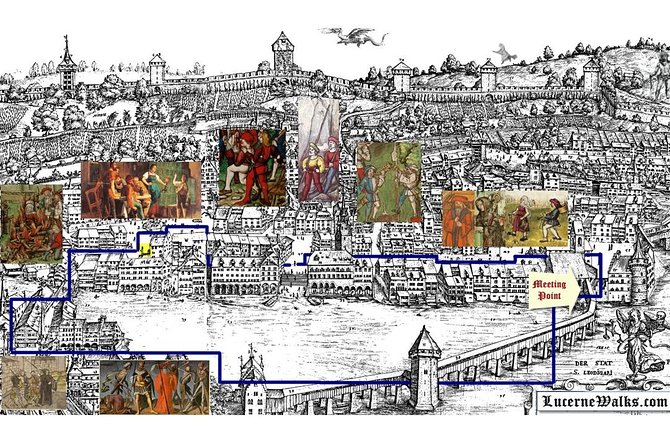
The tour begins at Rosengart Platz, near Peterskapelle, or St. Peter’s Chapel. The opening is theatrical without needing a stage: you hear a fire horn, followed by an invocation prayer, then the Nightwatchman introduces the hard realities of medieval city life.
This is a smart way to begin. Fire was a constant danger in old European towns, and a fire horn immediately gives the walk a practical starting point. The guide is not presenting medieval Lucerne as a clean, romantic fairy tale. You hear about the difficult work and uncertain life of a nightwatchman, then move into the city’s streets with that viewpoint in mind.
A projector is used here to introduce the medieval city. The star visual is the Martini plan, Lucerne’s first city map, dated 1597. You follow the evening route on the map and see that many buildings shown on it are still standing. That comparison helps you understand Lucerne as a living old town, not a collection of preserved scenery.
Peterskapelle dates to the 12th century and is described as the first church in town. Nearby is Lucerne’s first private stone house. The guide connects it with the old idea of being stone rich, a useful bit of social history that explains how building materials once signaled wealth and security.
The chapel itself is an important stop, but the experience is mainly a guided outdoor walk. Admission is not included at locations where an entry ticket might apply, so do not book this expecting a full interior tour of every historic building.
More Walking Tours in Lucerne
- Exclusive Private Lucerne Walking Tour with Local Guide 3 Hours
★ 5.0 · 80 reviews - Lucerne Half-Day Small Group Walking Tour incl. Lake Cruise
★ 4.5 · 15 reviews - Private 1.5-Hour Nightwatchman Walk in Medieval Lucerne
★ 5.0 · 15 reviews
Chapel Bridge and the Water Tower
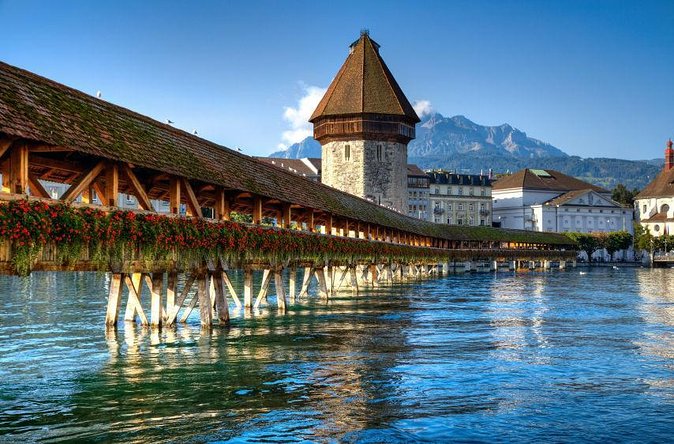
From the chapel, the walk moves to Lucerne’s best-known pair of landmarks: Chapel Bridge and the Water Tower. The guide explains a detail many visitors miss. The Water Tower came first, built in the late 13th century, while Chapel Bridge dates from 1365.
That fact alone changes how you see the waterfront. The Water Tower was not simply added as decoration beside the bridge. It was part of the city’s defensive system and has had several grim uses over the centuries. You see images of its interior and hear about the torture chamber, dungeon, and secret room.
The talk then turns to Chapel Bridge itself, including the reason for its name. Later, you cross the bridge and look at its roof paintings, while also learning why the bridge runs diagonally across the Reuss River. The route ends back near the bridge, so the opening and closing sections form a neat loop.
The bridge is free to view, and the tour does not require you to buy an attraction ticket here. That keeps the price focused on interpretation rather than admissions. If your main interest is simply photographing Chapel Bridge, you can do that on your own. The value of this walk comes from learning what you are looking at.
Furrengasse and the darker side of old Lucerne
The Nightwatchman turns toward Kapellplatz and Furrengasse, where the subject shifts from buildings to beliefs. You hear about life in the medieval Republic of Lucerne, a period when politics, religion, trade, and local customs were closely tied together.
This section includes a ghost and the Toggeli, described as an incubus or love robber. The stories are not polished museum labels. They are the sort of unsettling tales that help explain how people once understood illness, fear, bad dreams, and misfortune.
This is also where the evening format earns its keep. Narrow streets are easier to imagine as working lanes after sunset than in the middle of a busy sightseeing day. Still, the guide keeps the tone approachable. The walk is often funny as well as informative, and children can follow the stories, though parents should know that some medieval subjects are dark.
Kornmarkt, the giant, and old measurements
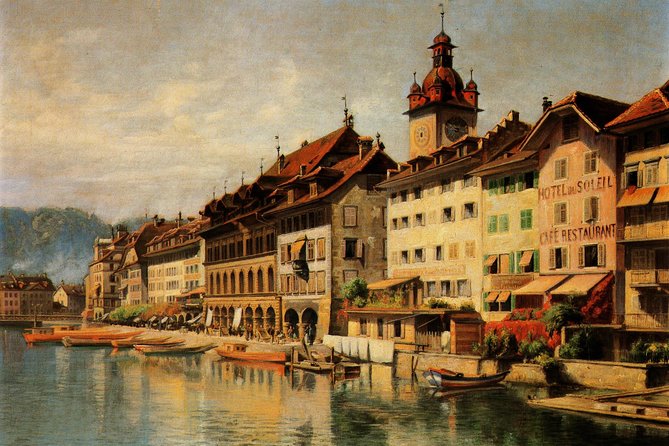
At Kornmarkt, the town hall square, the guide introduces the Renaissance Town Hall and its tower. One small detail catches my attention: the clock has no minute hand. In a world without modern timekeeping, an hour was often precise enough. That missing hand is a tiny clue to how differently city life was organized.
You also hear the story of the Giant of Reiden and see Lucerne’s old official measurements, the foot and the elle. These are not abstract units on a plaque. They show how a town regulated trade before standardized modern measures. A market square becomes easier to understand when you imagine merchants, goods, disputes, and officials checking lengths in public.
The stop lasts about 10 minutes, as do the other main points. That keeps the walk moving, but it means the guide cannot explore every building in detail. If you want a long architectural lecture on the Renaissance Town Hall, this is not the right format. If you want a useful layer of context while seeing the square, it works well.
Other guided walks around Lucerne:
- Lucerne Lakeside and Villas Private Walking Tour
★ 4.5 · 14 reviews - Lucerne Walking tour and Cheese Tasting
★ 5.0 · 11 reviews - Mt. Titlis Glacier & Lucerne Old Town Tour | From Lucerne
★ 5.0 · 10 reviews - Lucerne Private Walking Tour with a castle visit!
★ 5.0 · 7 reviews
Brandgässli, riots, and the old fish market
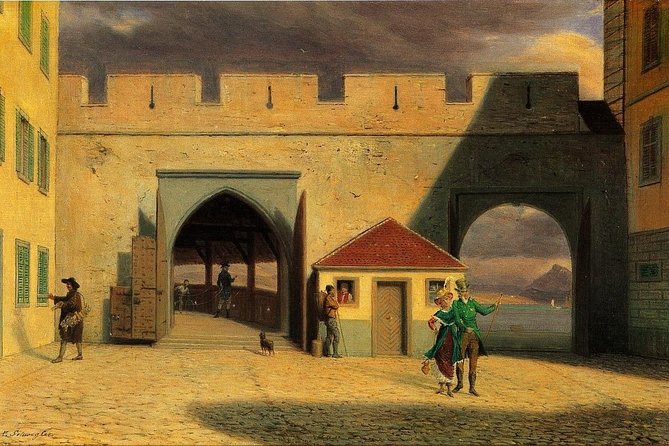
In Brandgässli, the subject turns to a riot in Lucerne. The walk then continues toward the former fish market, now known as the Weinmarkt. This transition is useful because it connects political unrest with the ordinary business of the city.
Lucerne’s old town was not only churches, towers, and handsome facades. It was also a place where food was sold, rules were enforced, and public anger could spill into the streets. The Nightwatchman’s stories give you a sense of those pressures without asking you to read a long historical account.
At Weinmarkt, you see old guesthouse signs and painted facades. The guide points out the former pharmacy of Renward Cysat, where a Latin inscription offers a wonderfully bleak medical opinion: there is no cure for a broken heart. You then hear about the Reformation and Counter-Reformation while drinking a small sample of Lucerne fountain water.
The water tasting is a simple touch, but it helps break up the talk and makes the stop feel local rather than academic. Bring a raincoat or umbrella if the forecast is poor. The tour operates in rain and snow, and the water tasting is not a reason to expect a sheltered route.
Im Zöpfli and medieval justice
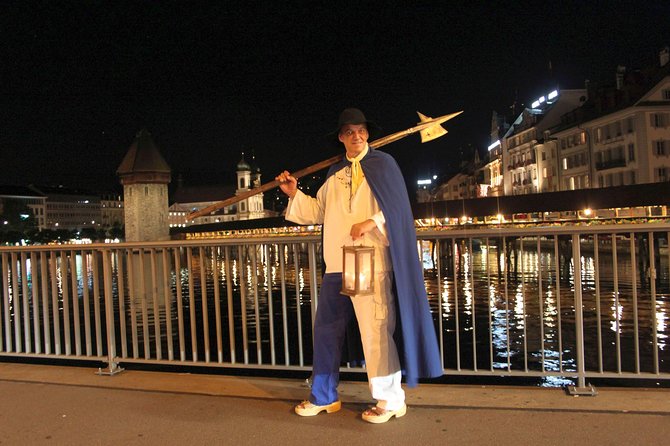
At the riverside square called Im Zöpfli, the guide explains law and order in old Lucerne. This is one of the more serious portions of the walk. Projected paintings show methods of prosecution, interrogation, and corporal punishment used in the Middle Ages.
The visual material matters here. Medieval punishment can sound like a list of grim words when explained only aloud. Seeing the projected scenes gives the subject a clearer shape, though it also makes this section unsuitable for anyone who prefers to avoid graphic history.
The walk then crosses the Reussbrücke, with views toward Spreuerbrücke, also called the Mill Bridge, the Needle Dam, and sections of the Musegg Wall. These landmarks broaden the picture beyond the immediate old town. You are seeing parts of Lucerne’s water control and defensive systems in one short stretch.
The guide does not appear to pause for long interior visits at each landmark. Instead, the route uses viewpoints and street-level interpretation. That is why comfortable shoes and a willingness to keep moving matter more than formal sightseeing clothes.
The old pharmacy window and guardian demons
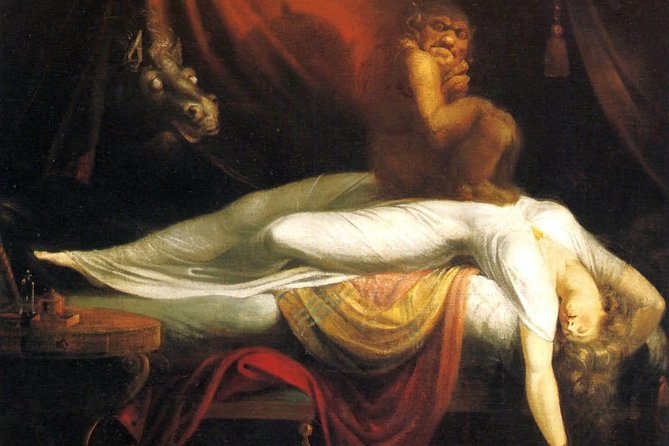
A few steps farther, the tour reaches the medieval pharmacy window of the Alte Suidtersche Apotheke. This is one of the route’s more visually memorable details. A pharmacy window can be easy to overlook when you are focused on the river and bridges, so having the Nightwatchman point it out gives the building a place in the story.
The guide also shows guardian demons and explains the house and its location. Lucerne’s old facades often carry symbols, painted decoration, signs, and carved figures. You will get more from them if someone explains what to look for.
The route’s emphasis on small details is a strong reason to book this instead of simply taking an unescorted evening walk. You still have time to admire the architecture, but you are less likely to pass the odd pharmacy window or strange guardian figure without noticing it.
Ritterscher Palace and the Dance of Death
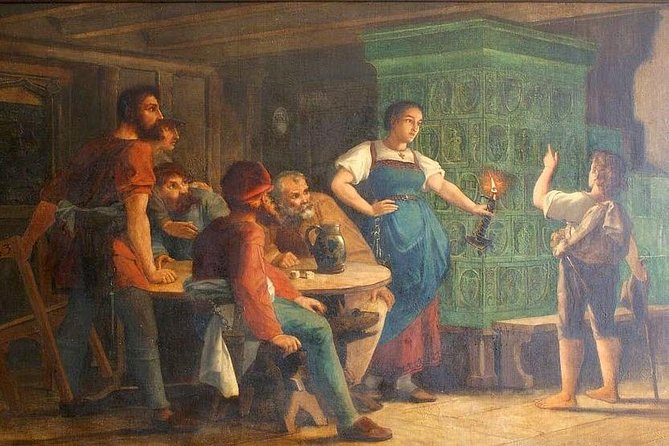
At Ritterscher Palace, the Nightwatchman tells the story of the house of Lux Ritter and explains why the first two floors differ from the third. This is classic old-town reading: the facade is not just decoration, and changes in construction can hint at different periods, functions, or owners.
You also hear about Hans von Trient, an unlucky stonemason. The story adds a human face to the stonework around you. Medieval buildings were made by workers with dangerous jobs, not by anonymous history-book figures.
The highlight here is the projected presentation of seven paintings from the Dance of Death. The images appear on a house wall while the guide explains them. This is an effective use of the evening setting. A blank wall becomes a temporary screen, and the theme fits the tour’s recurring focus on mortality, social order, and the fragile nature of medieval life.
The material can be gory at times. That is worth considering before bringing younger children, even though children up to age 12 are free when accompanied by an adult. The tour is family-friendly in pace and tone, but not sanitized.
Jesuit Church and the return across Chapel Bridge
On the way back, you pass the Church of the Jesuits, identified as the first Baroque building in Switzerland, dating from 1677. This gives the walk a useful later chapter. The route begins with medieval Lucerne but does not pretend the city stopped changing after the Middle Ages.
The final stop returns to Chapel Bridge. You cross it, look at the roof paintings, and learn more about its diagonal construction over the river. Ending where the walk began makes orientation easy. You are not left on an unfamiliar street after dark, and you can continue exploring the waterfront or old town on your own.
The full experience lasts about 90 minutes. The stops are short, generally around 10 minutes each, with walking time between them. One past participant found the pace a little quick, so tell your guide if you need a slower walk. The group limit of 15 should make questions possible, although the amount of material means you will not get an answer to every historical curiosity.
What the $39.54 price gives you
At about $39.54 per person, this is a fair price for a small-group, 90-minute guided walk in central Lucerne. You are paying for a costumed local guide, the projector and visual material, historic postcards, and the guide’s ability to connect scattered sights into one story.
The postcards are a pleasant extra, especially because they feature old Lucerne artwork. The most useful inclusion, though, is the visual presentation. The Martini plan and projected images would be difficult to recreate on your own during a short visit.
The tour does not include hotel pickup or drop-off. That is not much of a problem because the start and finish are both at Rosengart Platz, near major old-town sights and public transportation. Admission tickets are not included at the few stops where an entry ticket may apply, but the walk itself is built largely around streets, squares, bridges, facades, and views.
The experience is offered in English and has received a 4.7 rating, with 94 percent of customers recommending it. Those figures suggest a dependable choice, but the content matters more than the numbers. You should book it for interpretation, stories, and atmosphere, not for a series of paid interior admissions.
Who will enjoy this evening walk
I would choose this tour if you want a quick but substantial introduction to Lucerne’s old town. It suits first-time visitors who want to understand the city before exploring it alone, and it also works after a few days in town because the guide can reveal details you may have walked past.
Families can enjoy the humor, map, bridge stories, and visual material. Parents should prepare children for discussions of torture, punishment, death, and dark folklore. History fans will appreciate the Martini plan, old measurements, Reformation stories, and architectural clues.
The tour is also a good fit for anyone who has already taken a standard daytime city walk. The subject is narrower and more theatrical, with the Nightwatchman character shaping the evening. Guides have included Ralf, who was described as personable and effective at showing how historic buildings are still used.
I would skip it if you dislike walking in poor weather, need frequent long pauses, or want extensive time inside each landmark. The tour runs rain, snow, or shine. Wear weather-appropriate clothes and bring an umbrella or raincoat. Service animals are allowed, and most people can participate, but the group keeps moving through the old town.
Should you book the Nightwatchman Walk?
Book it if you want history with a human voice, not just a checklist of Lucerne sights. The best parts are the Martini plan, the projected Dance of Death paintings, the stories at the Water Tower and Weinmarkt, and the chance to see familiar landmarks in a new light.
For about $39.54, you get a focused evening route, a small group, visual material, postcards, and a guide who brings medieval Lucerne to life without requiring a museum ticket at every stop. Just allow for the quick pace, outdoor conditions, and occasional grim subject matter.
If you have only one evening in Lucerne and want more than photographs of Chapel Bridge, this is a strong choice. If you mainly want quiet sightseeing or detailed interior visits, explore the old town independently instead.
FAQ
How long does the Nightwatchman Walk last?
The walk lasts approximately 1 hour and 30 minutes.
Where does the tour start?
It starts at Rosengart Platz, 6004 Luzern, Switzerland.
Where does the tour finish?
The tour ends back at the meeting point near Rosengart Platz.
What language is the tour offered in?
The tour is offered in English.
How large is the group?
The group has a maximum of 15 travelers.
Are children allowed on the tour?
Yes. Children up to 12 years old are free, but they must be accompanied by an adult.
Does the tour run in bad weather?
Yes. Tours operate in rain, snow, or shine. You should dress for the weather and bring an umbrella or raincoat.
Is hotel pickup included?
No. Hotel pickup and drop-off are not included.
Can I cancel for a full refund?
Yes, if you cancel at least 24 hours before the experience start time. Cancellations or changes made less than 24 hours before the start are not accepted for a refund.
Just added in Lucerne
- Private Transfer: Lucerne to Zurich Airport ZRH by Luxury Van★ 4.5 · 6 reviews
- The Lives and Legends of Lucerne: A Self-Guided Audio Tour★ 5.0 · 6 reviews
- Private Transfer: Lucerne to Zurich Airport ZRH by Business Car★ 5.0 · 11 reviews
- Weggis Vitznau Foxtrail Helios★ 4.5 · 8 reviews
- Tandem Flight Zurich-Engelberg★ 5.0 · 7 reviews
- Touristic highlights of Lucerne on a Private half day tour with a local★ 4.0 · 5 reviews
- Panoramic E-Bike Tour with a Lake Cruise★ 5.0 · 10 reviews
- Paragliding Tandem in Switzerland★ 5.0 · 9 reviews
Walking Tours, compared.

Award-Winning Geneva Chocolate &Old Town Tour with Boat Ride (3h)
Read our review →
Zurich Walking Tour With Cruise and Aerial Cable Car
Read our review →
3 in 1: Zurich Walking Tour – Cruise on the Lake – Cable Car Ride to Felsenegg
Read our review →
Bern Walking Tour: Explore Top Sights & Hidden Gems
Read our review →Browse the lists this tour appears in